
Few cars have the charisma, heritage, and road presence that the Chevrolet Corvette commands. Since its debut in 1953, the Corvette has stood as a bold symbol of American engineering and muscle. From fiberglass bodies to thunderous V8 engines, the classic Corvette wasn’t just a car — it was a revolution on wheels.
🏁 The Birth of an Icon (1953)
The first Corvette rolled out in 1953 as a sleek two-seater roadster with a fiberglass body — a groundbreaking innovation at the time. It featured a 3.9L inline-6 engine and a two-speed Powerglide automatic transmission. Though modest in performance by today’s standards, its styling and uniqueness carved a niche in the American dream.
🚀 The Muscle Era: Sting Ray & Big Blocks (1960s)
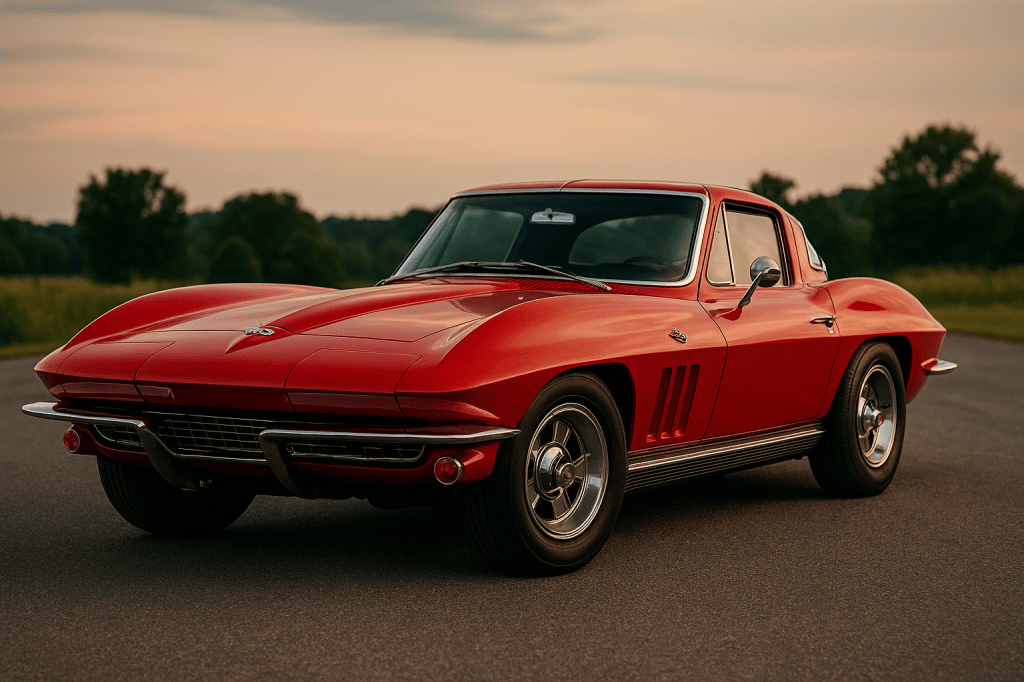
The 1960s brought serious performance upgrades. The second-generation Corvette Sting Ray (1963–67) introduced split rear windows, hidden headlights, and aggressive styling. Under the hood? Massive V8s like the 427-cubic-inch (7.0L) engines that produced up to 435 hp. Corvette was no longer just cool — it was fast.
With names like L88, ZL1, and LT-1, these powerplants became legends of the street and strip. Corvette also introduced independent rear suspension — a rarity in American muscle — giving it real sports car handling.
🎯 Corvette in Pop Culture
From Route 66 to Hollywood action flicks, the Corvette became a cultural symbol. It was the car of astronauts, celebrities, and rockstars. The Corvette wasn’t just parked in garages — it was plastered on posters, featured in songs, and burned into the hearts of a generation.
⚙️ Engineering Milestones
- 1953: First American production sports car with a fiberglass body.
- 1963: Introduction of the split-window Sting Ray and IRS.
- 1967: The L88 Corvette — a factory race car disguised as a road car.
- 1970s: The Corvette remained a performance beacon even during the muscle car decline.
🏁 Corvette Engine & Design Details
1. Engine Lineage & Technical Evolution:
Small‑block to Big‑block: Started with the small‑block 327 ci V8 in the ’60s (e.g., L79 at 350 hp) and big‑blocks like the L72 427 ci delivering up to 435 hp in ’66–’69 .
LT1/C4: The 1992 LT1 5.7 L V8 used reverse‑flow cooling and Opti‑Spark, making ~300 hp with better emissions/efficiency .
Modern Powerhouses:
C7 Z06: supercharged 6.2 L LT4 – 650 hp/650 lb‑ft .
C6 ZR1: LS9 6.2 L supercharged – 638 hp, first 200 mph Corvette .
C7 ZR1: LT5 6.2 L supercharged – 755 hp/715 lb‑ft .
C8 Z06: LT6 5.5 L flat‑plane DOHC – 670 hp at 8,400 rpm, 8,600 rpm redline .
Upcoming C8 ZR1: twin‑turbo 5.5 L flat‑plane – 1,064 hp, 215+ mph .
2. Design & Architecture:
Early C1/C2 used front‑engine layouts; C8 features a mid‑engine setup improving weight distribution .
LT6 design highlights: aluminum block, DOHC heads, titanium rods, dry‑sump, split intake, and headers for high‑revving performance .
—
🔧 The Cult Following
The Corvette is iconic with a passionate fan base—especially models like the 1957 fuel‑injected 283 V8, C2 Z06 race packages, and rare C4 ZR‑1s with LT5s—valued for both performance and heritage .
Its reputation as “America’s sports car” endures through active clubs, high aftermarket support, and legendary straight‑line and track performance.
—
🛞 Wheels & Tires (C8 Z06 Example)
Standard wheels: 20″ front, 21″ rear, with option for carbon‑fiber rims .
Tire sizing: 275/30ZR20 (front), 345/25ZR21 (rear); premium track setup with Michelin Cup 2 R ZP .
Aerodynamic, multi‑spoke wheels provide rigidity and lower unsprung mass, especially with carbon‑fiber options.
—
⛽ Fuel & Efficiency
Historic Tanks: 1965 coupes offered a 36‑gal fuel tank; exhaust and traction package options added trade‑offs .
Modern Models:
GT‑era tanks remain around 22–24 gal.
E‑Ray hybrid adds AWD front electric motor, preserving fuel tank and adding efficiency; Stingray delivers around 490–495 hp from 6.2 L .
Performance focus limits MPGs, but hybrids offer slight city‑driving gains .
🔥 Why the Corvette Classic Still Matters
Classic Corvettes are highly prized by collectors and enthusiasts. They’re a reminder of when American design, raw horsepower, and bold ambition came together. Whether it’s a chrome-bumpered C1 or a fire-breathing C3, every generation of classic Corvette carries the DNA of the original rebel roadster.
🧭 Conclusion
The Chevrolet Corvette Classic isn’t just an old car — it’s a living piece of American automotive history. It laid the groundwork for performance cars to come and still inspires with its timeless styling and unmistakable presence.
Have you ever driven a classic Corvette or seen one up close? Share your memories or dream spec in the comments below!
 Ignition Garage