
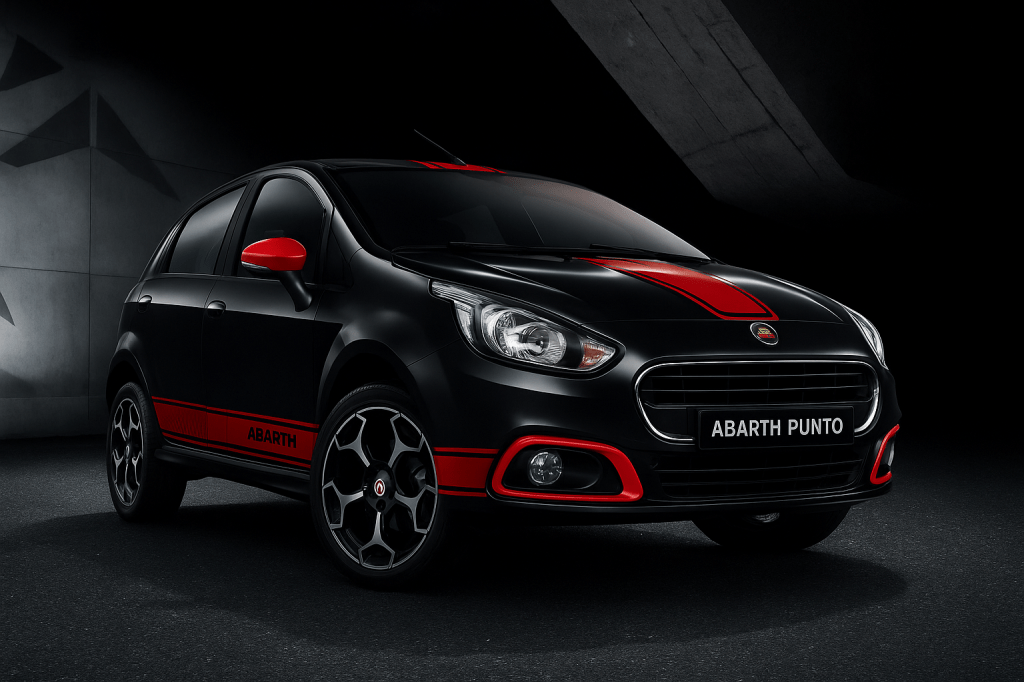
Category: Performance Hatchbacks
Segment: Power Hatch | Mid-Spec Performance
In a world where manufacturers flirted with the idea of sportiness, Fiat didn’t just participate — they went full Abarth. The Punto wasn’t just “tuned” — it was transformed. A larger 1.4L T-Jet turbo engine, retuned suspension, brakes, and attitude poured into every panel — the Abarth Punto was a full-fat performance car in hatchback clothing.
No compromises. No “warm hatch” energy. This was India’s first true hot hatch.
—
🔧 Engine & Transmission
Engine: 1.4L T-Jet Turbo Petrol, 4-cylinder
Power: 145 PS @ 5,500 rpm
Torque: 212 Nm @ 2,000–4,000 rpm
Transmission: 5-speed manual
0–100 km/h: 8.8 seconds
Top Speed: ~190+ km/h
The throttle wasn’t refined — it was explosive. It pinned you back when the turbo spooled, and the boost delivery was raw, mechanical, and addictive. It had soul, something modern hatches rarely offer.
—
💨 Driving Character
This Punto was heavier than rivals, but still the sharpest handler of the bunch — thanks to its independent suspension, low stance, and aggressive chassis tuning.
Suspension: Lowered ride height, stiffer dampers
Steering: Hydraulic – heavy, alive, loaded with feedback
Brakes: All 4 disc brakes – confidence-inspiring
Tyres: 195/55 R16 Apollo Alnac – grippy, firm
Chassis Balance: Neutral handling, good high-speed composure
This car didn’t ask to be driven fast — it demanded it.
—
🏁 Abarth-Specific Performance Features
Abarth engine + turbo tuning (T-Jet)
Stiffer suspension and lowered ride height
Four-wheel disc brakes
Abarth body kit: red OR yellow accents
Signature Scorpion badges front, rear, and wheels
Matte grey alloys and dual-tone bumpers
No badge engineering here — the Abarth Punto was a factory-tuned beast, not a sticker job.
—
🎨 Design & Identity
Subtle aggression is where the Punto excelled. The optional red OR yellow detailing, Scorpion stripes, and muscular stance made it look purely performance-bred — without being garish.
Paint Options: Pearl White, Hip-Hop Black, Exotica Red
Accents: Contrast mirrors, front splitter, and decals
Wheels: 16” Gunmetal Abarth alloys
Badging: Scorpion logos on bonnet, tailgate, wheels
Instantly recognizable. Instantly desirable.
—
🛋 Interior & Features
Abarth scorpion-embossed leather-wrapped steering
Red contrast stitching and dark grey dashboard theme
Manual air-con, power windows
Basic infotainment (but this car wasn’t about screens)
Dual airbags + ABS
The cabin was dated even back then — but the moment you gripped the wheel, you didn’t care.
—
🔋 Mileage & Practicality
Fuel Efficiency (claimed): 16.3 km/l
Real-World Mileage: 9–11 km/l (spirited driving)
Boot Space: 280 litres
Tank Capacity: 45 litres
Fuel bills were heavy — but so was the grin on your face.
—
🚘 Competitors (Then & Now)
Car Engine Power USP
Polo GT TSI 1.2L Turbo Petrol 105 PS German engineering, DSG transmission
Baleno RS 1.0L Boosterjet Turbo 102 PS Light, practical, efficient
Figo S 1.5 Petrol 1.5L NA Petrol 110 PS NA fun, old-school handling
i20 N Line 1.0L Turbo GDi 120 PS Tech-loaded, refined and stylish
Abarth Punto 1.4L T-Jet Turbo 145 PS Full-on performance. No compromise.
🔥 Ignition Garage Verdict
The Fiat Abarth Punto was bold, brash, and ballistic. It wasn’t for everyone — but for those who “got it,” there was nothing else quite like it. It didn’t care about fuel economy, screens, or polished marketing — it lived to be driven.
The Italian Hot Hatch That India Never Understood
Being India’s first true hot hatch, the Abarth Punto wasn’t just a car — it was a manifesto. A car built from the ground up, not rebadged. From its turbocharged heart to its tightened suspension and distinctive Abarth detailing, this was no cosmetic upgrade — this was real performance engineering, unleashed.
Under the hood, the 1.4L T-Jet Turbo produced a jaw-dropping 145 bhp — a figure that still outguns most so-called sporty hatchbacks today. It wasn’t just quick in a straight line; it was heavy, grippy, and built for men who could tame machines, not boys chasing badges.
Its competitors could barely keep up on paper, let alone on the road. But India wasn’t ready. Most buyers dismissed it. And so, Fiat silently pulled the plug, leaving behind a limited batch of Abarth Puntos that today exist as rare collector-grade sleepers, whispered about in enthusiast circles.
Ask a true petrolhead what defines a driver’s car — they won’t say touchscreen size or wireless Android Auto. They’ll say “feel”, and the Abarth Punto had it in abundance. It was heavy where it needed to be, loud where it wanted to be, and beautifully unapologetic about its flaws. It didn’t try to be everything for everyone. It stayed true to one thing — the love of driving.
Today, Fiat may no longer exist in Indian showrooms, but their engineering legacy — especially through the Abarth Punto — lives on in every owner who still holds the keys. Those who drive one know: it’s not just a car. It’s a pulse, built with soul, crafted for the roads less driven.
The Fiat Abarth Punto — Born Mad. Died a Legend. Still Worshipped.
| Specification | Details |
|---|---|
| Engine | 1.4L T-Jet Turbo Petrol |
| Power | 145 PS @ 5,500 rpm |
| Torque | 212 Nm @ 2,000–4,000 rpm |
| Transmission | 5-speed Manual |
| 0–100 km/h | 8.8 seconds |
| Top Speed | 190+ km/h |
| Brakes | All 4 Disc Brakes |
| Wheels | 16″ Gunmetal Alloys |
| Fuel Efficiency | 16.3 km/l (claimed) |
| Boot Space | 280 litres |
 Ignition Garage