
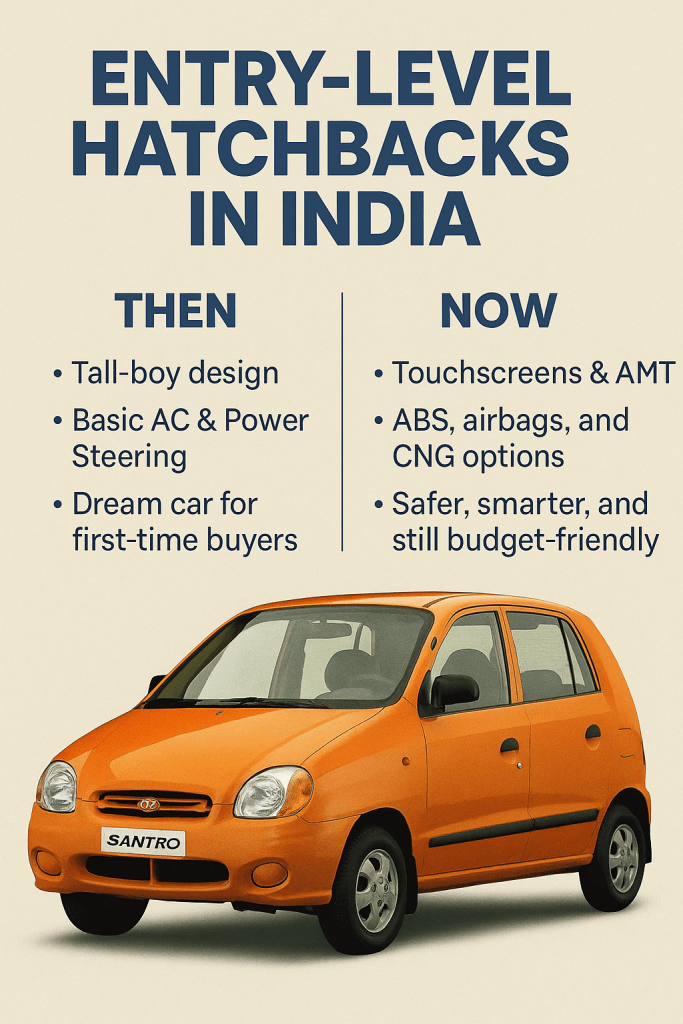
The Indian car market witnessed a revolutionary transformation in the late 1990s when compact, affordable hatchbacks began dominating the roads. These cars weren’t just vehicles – they were symbols of aspiration for the middle class. This blog revisits the journey of the entry-level hatchback in India, from humble beginnings to today’s tech-packed small cars.
🚘 The Pioneer: Hyundai Santro (1998)
Launched in 1998, the Hyundai Santro changed the Indian car landscape forever. With its unique “tall boy” design, powerful 1.0L engine, and modern Multi-Point Fuel Injection (MPFI) system, it brought a blend of practicality and innovation previously unseen in the segment. It was compact yet spacious, easy to drive, and came with features that rivaled sedans at the time.
The Santro quickly became a household name and introduced Hyundai as a serious competitor to established Indian manufacturers. It was one of the first hatchbacks to offer power steering, AC, and even a premium automatic variant in the entry segment.
🏁 The Rivals Arrive
- Maruti Suzuki Zen: The stylish, sporty hatch that appealed to youth. More refined but costlier than the Santro.
- Tata Indica (1998): India’s first indigenous hatchback. Known for its space and diesel option.
- Maruti Alto (2000): The car that would eventually dethrone the Zen and Santro in sales. It was budget-friendly, fuel-efficient, and easy to maintain.
- Chevrolet Spark (2007): Formerly Daewoo Matiz, relaunched with GM support, it brought funky styling and zippy performance.
- Hyundai Eon (2011): Hyundai’s successor to the Santro aimed at the Alto segment with modern styling and a 0.8L engine.
🚗 The Modern Era: Today’s Entry-Level Hatchbacks
While the market has shifted towards SUVs, entry-level hatchbacks still remain popular as the first car for many. Today’s hatchbacks are feature-rich, safer, and far more refined than their earlier versions. Here are the prominent players in 2024–25:
- Maruti Suzuki Alto K10: A tried-and-tested formula with a 1.0L engine, now with SmartPlay infotainment and AMT options.
- Hyundai Grand i10 Nios: Offers touchscreen, wireless charging, and even CNG variants – a premium choice for its segment.
- Tata Tiago: Known for its build quality, safety (4-star GNCAP), and value-for-money package.
- Renault Kwid: Compact SUV-inspired styling with digital instrument cluster and touchscreen – a bold choice for city driving.
🧭 Conclusion: The Evolution Continues
From the Santro’s revolutionary entry in 1998 to the tech-savvy hatchbacks of 2025, India’s entry-level car story reflects the changing needs and aspirations of the Indian consumer. As EVs and hybrids start entering the segment, the humble hatchback is evolving again – smarter, cleaner, and more connected than ever.
What was your first hatchback? Let us know in the comments below, and stay tuned to Ignition Garage for more auto throwbacks and future insights.
 Ignition Garage